
Microsoft
Azure Cloud Modernization:
A Practical Roadmap for Secure, Scalable and Future-Ready Businesses.
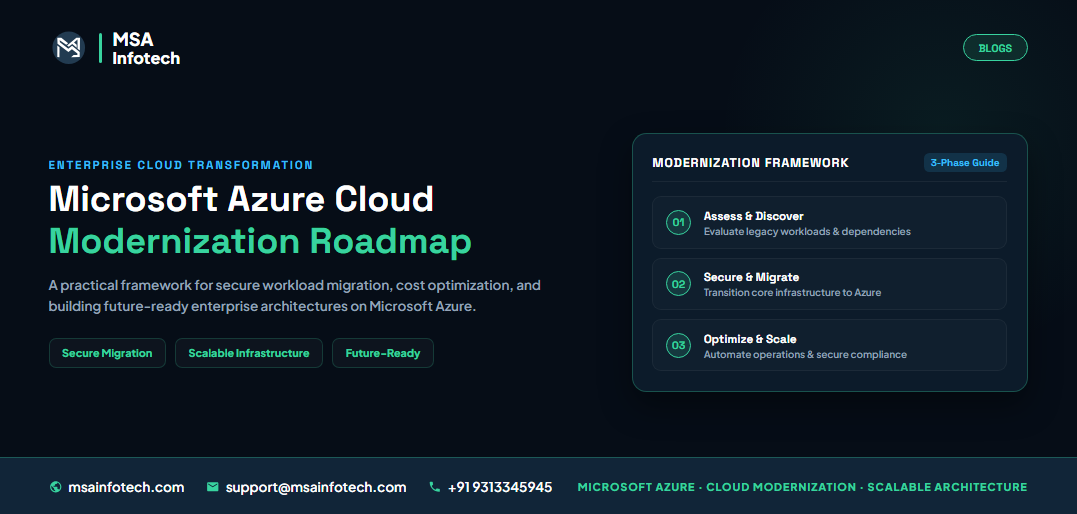
How organizations can modernize applications, data and infrastructure with Microsoft Azure while balancing security, scalability, performance and cost.
|
EXECUTIVE TAKEAWAY Cloud
modernization is not simply about moving applications from on-premises
infrastructure to the cloud. A successful Azure strategy combines migration
planning, application modernization, security, data platforms, automation and
continuous optimization to create a more agile and resilient business
environment. |
Introduction:
Why Cloud Modernization Matters
As businesses
grow, their technology environments often become a combination of legacy
applications, on-premises infrastructure, databases, third-party systems and
newer digital workloads. Cloud modernization provides an opportunity to rethink
how applications, infrastructure and data are designed and operated. Microsoft
Azure offers capabilities that can help organizations modernize at a pace that
matches their business priorities.
Microsoft
Azure as a Modernization Platform
Microsoft Azure
provides a broad foundation for modernizing enterprise technology.
Organizations can use Azure to migrate existing systems, modernize
applications, build cloud-native solutions, integrate business systems,
establish modern data platforms and introduce analytics or AI capabilities.
·
Infrastructure
modernization for scalable and resilient workloads.
·
Application
modernization for improved performance and maintainability.
·
Database
and data-platform modernization for analytics.
·
Integration
and API capabilities for connected business systems.
·
DevOps
and automation for faster, more reliable delivery.
·
Security,
governance and monitoring across the cloud environment.
The Azure Cloud Modernization Roadmap
A structured
roadmap helps organizations reduce risk and avoid treating cloud migration as a
one-time technical exercise.
|
1. Assess |
2. Plan |
3.
Migrate |
4.
Modernize |
5.
Optimize |
|
Understand workloads, dependencies and risks. |
Define architecture, priorities and governance. |
Move suitable workloads to Azure. |
Improve applications, data and operations. |
Continuously improve cost, security and performance. |
Choosing the
Right Azure Modernization Strategy
Different
applications have different constraints. Selecting the right approach helps
balance speed, investment, risk and long-term value.
|
Approach |
Best For |
Typical
Goal |
|
Rehost |
Workloads needing a relatively fast move |
Move with minimal changes |
|
Refactor |
Applications suited to incremental cloud improvement |
Improve efficiency |
|
Rearchitect |
Applications requiring greater scale or resilience |
Change architecture |
|
Rebuild |
Outdated or highly constrained applications |
Create a modern solution |
|
Replace |
Workloads better served by SaaS |
Reduce custom maintenance |
Security,
Governance and Cost Optimization
Security and
governance should be designed into the modernization journey rather than added
after workloads are moved. Organizations also need visibility into resource
usage and operating costs as their Azure environment grows.
·
Identity
and access controls based on least-privilege principles.
·
Data
protection and encryption.
·
Network
security and controlled connectivity.
·
Governance
policies for resources and environments.
·
Monitoring
and logging for operational visibility.
·
Cost
management and continuous optimization.
Azure Data, Analytics and AI
Modernization
becomes more valuable when operational data can be turned into timely business
insight. Azure can support modern data platforms, analytics and AI workloads
that connect information from different parts of an organization.
·
Centralized
and governed data platforms.
·
Business
intelligence and management dashboards.
·
Operational
visibility through timely data.
·
Predictive
analytics and machine learning use cases.
·
AI-enabled
applications and intelligent business processes.
Building a Future-Ready Azure Architecture
A future-ready architecture connects business applications, cloud services, data, analytics and AI while maintaining security, governance and operational visibility
|
Business
Applications |
Web
• Mobile • ERP • Line-of-business systems |
|
Microsoft
Azure |
Apps
• APIs • Cloud Infrastructure • Integration |
|
Data
Platform |
Operational
Data • Data Engineering • Analytics |
|
AI
& Analytics |
BI
• Machine Learning • AI-enabled experiences |
|
Cross-Cutting
Foundation |
Security
• Governance • Monito |
.
MSA Infotech can position its Azure capabilities around the complete modernization lifecycle:
·
Azure
consulting and cloud strategy aligned with business objectives.
·
Azure
migration planning and execution.
·
Application
modernization for scalability, maintainability and performance.
·
Data
and analytics solutions for better visibility and decision-making.
·
Security
and governance practices for cloud environments.
· Ongoing optimization for reliability, performance and cost efficiency.
Key Takeaways
|
· Azure modernization is
more than infrastructure migration.
· Every
workload needs the right modernization strategy. |