
MODEL CONTEXT PROTOCOL (MCP)
How AI Agents Connect with Business Tools
Artificial Intelligence • Agentic AI • Enterprise Integration
|
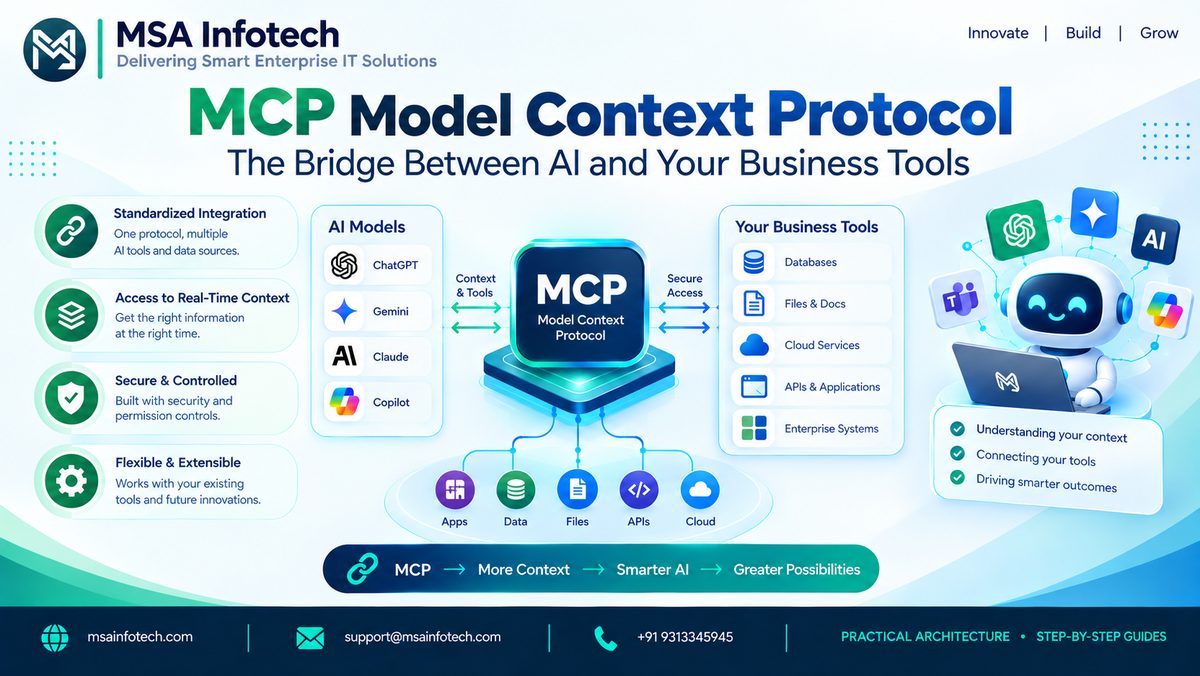
KEY TAKEAWAY MCP acts as a standard connection layer between AI
agents and the tools they need to perform tasks. It provides a common
approach for exposing capabilities to AI systems. |
What Is Model Context Protocol (MCP)?
Artificial Intelligence is
rapidly changing how businesses interact with software and data. Modern AI
agents can understand goals, reason through tasks, and take actions. But to
complete real business tasks, an AI agent often needs access to external tools,
applications, databases, files, and services.
This is where Model
Context Protocol (MCP) becomes important.
MCP is an open standard
that provides a consistent way for AI applications and agents to interact with
external tools and data sources. Instead of creating a different custom
integration for every AI application and every tool, MCP provides a common
protocol for exposing capabilities to AI systems.
|
IN
SIMPLE TERMS MCP acts as a standard connection layer
between AI agents and the tools they need to perform tasks. |
Why Do AI Agents Need MCP?
An AI model by itself can
generate text and reason about information, but business automation often
requires more than generating an answer.
An AI agent may need to:
1 Understand the customer's
request.
2. Identify the required information.
3. Access the order management system.
4. Retrieve the customer's order.
5. Check the delivery status.
6. Return the information to the customer.
Without a standardized
approach to tool integration, developers may need to build and maintain
multiple custom connections.
MCP provides a common
approach for exposing tools and resources to AI applications. This makes it easier
to build AI systems that can move from answering questions to performing useful
actions.
How Does MCP Work?
A simple way to understand
MCP is to think of it as a communication layer between an AI application and
external capabilities.
Basic flow:
|
User Goal |
AI Agent |
MCP |
Business Tool |
Result |
AI Agent |
User |
For example:
|
Customer |
AI Agent |
MCP |
CRM |
Customer Information |
AI Agent |
Response |
An MCP-based architecture
generally involves an AI application acting as the client and one or more MCP
servers exposing tools or other capabilities.
|
MICROSOFT
CONTEXT Microsoft's current Azure documentation describes
MCP as a way for applications to provide capabilities and context to large
language models, with tools that AI agents can use to complete tasks. |
What Is an MCP Server?
An MCP server is a
component that exposes tools, resources, or other capabilities that an
MCP-compatible AI application can use.
For example, an MCP server
could provide access to:
· Databases
· Business applications
· Files
· Search systems
· APIs
· Cloud services
· Development tools
· Internal enterprise systems
Microsoft's documentation
currently describes MCP servers as a way to expose tools that agents can
invoke, including through Azure and Microsoft Foundry environments.
|
AI Agent |
MCP Server |
Business Tool / Data Source |
The MCP server handles the
connection between the AI application and the capability being exposed.
The real value of MCP
becomes clearer when AI agents need to work with multiple systems.
Consider a sales AI agent.
It may need to:
· Search customer information.
· Retrieve previous interactions.
· Check product information.
· Update CRM records.
· Create follow-up tasks.
· Generate a summary.
An MCP-based architecture
can expose appropriate capabilities to the agent.
The workflow could look
like:
|
Sales Request |
AI Agent |
MCP |
CRM + Product
Database + Business Tools |
AI Agent Processes
Results |
Action / Response |
This allows AI agents to
become more useful within real business workflows.
Benefits of Model Context Protocol
|
Standardized Integration A common protocol for connecting AI
applications with tools and data sources. |
Faster AI Development Reusable integrations instead of different
approaches for every AI application. |
More Capable AI Agents Agents can interact with tools and business
systems instead of only generating responses. |
|
Reusable Tool Connections An MCP server can expose capabilities to
multiple MCP-compatible clients. |
Scalable AI Applications The latest specification includes changes
aimed at scalability, routing, caching, and deployment flexibility. |
Practical Enterprise Value Standardized connectivity helps AI move
into real business workflows. |
Security and Governance Considerations
Connecting AI agents to
business systems also introduces important security considerations.
Organizations should
carefully manage:
·
Authentication – Who is
allowed to connect?
·
Authorization – What can the AI agent access?
·
Tool permissions – Which
tools can the agent use?
·
Data privacy – What information is being shared?
·
Monitoring – What actions
are being performed?
·
Human approval – Which
actions require a person to approve them?
·
Auditing – Can important
actions be reviewed later?
|
ENTERPRISE CONTROL Microsoft's current guidance recommends
controlling allowed tools and requiring approval for high-risk operations,
particularly operations that write data or change resources. |
This is especially
important for enterprise applications where AI agents may interact with
sensitive business data.
AI is moving from systems
that simply generate responses toward systems that can reason, use tools, and
complete multi-step workflows.
MCP is becoming part of
this evolution by providing a standardized way for AI applications to interact
with external capabilities.
The MCP project released
its 2026-07-28 specification with a stateless protocol core, improved
authorization, caching capabilities, Tasks, and an extensions framework. The
MCP roadmap is also focusing on areas such as agent communication,
enterprise-ready security, transport scalability, and developer experience.
As AI agents become more
common in enterprise applications, standardized tool connectivity can become
increasingly important.
The future may not be about one AI model working alone. Instead, businesses may use AI agents that can securely interact with many different systems, tools, and data sources to complete meaningful workflows.
How
MSA Infotech Helps Businesses Adopt AI
Adopting AI is not only
about choosing an AI model. Businesses also need to understand their workflows,
existing applications, data, security requirements, and automation
opportunities.
MSA Infotech helps
businesses explore modern technology solutions across areas such as AI and
Machine Learning, Agentic AI, Microsoft technologies, cloud applications,
software development, and enterprise solutions.
By combining AI
capabilities with existing business systems and applications, organizations can
explore practical opportunities for intelligent automation and digital
transformation.
Whether the goal is to
improve customer support, automate business processes, modernize applications,
or build intelligent enterprise solutions, the right architecture and
integration strategy are essential.
Conclusion
Model Context Protocol (MCP) provides a standardized way for AI agents to connect with tools, data, and business applications. As businesses move toward Agentic AI and intelligent automation, MCP can help make AI agents more connected, capable, and useful in real-world workflows
“With MCP, AI agents don’t just understand — they connect, act, and automate.”