
 DATA & ARCHITECTURE
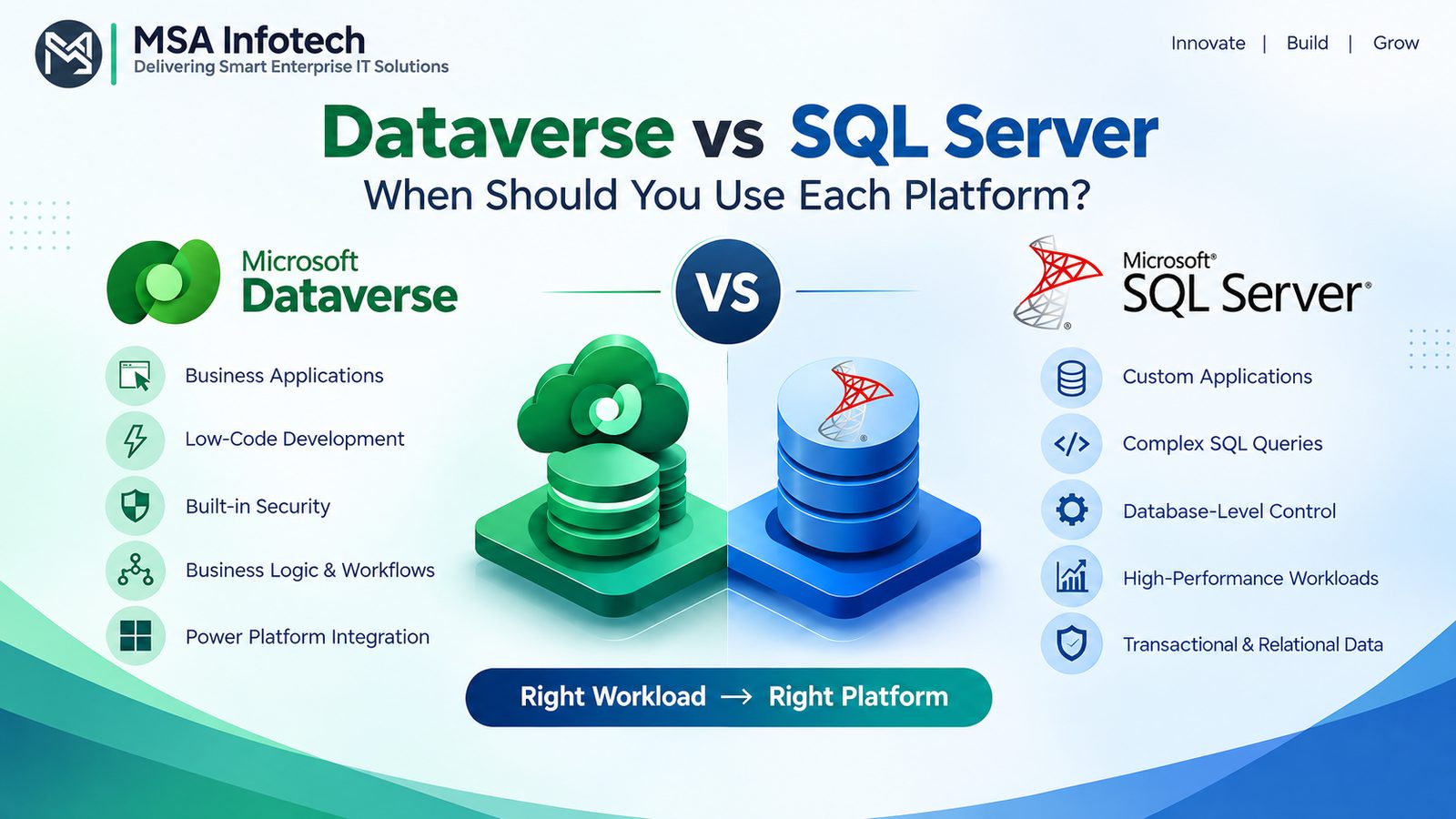
Dataverse vs SQL Server:
When Should You Use Each Platform?
Executive Summary Dataverse and SQL Server are both powerful data platforms, but they are optimized for different architectural priorities. Dataverse is designed around business applications, managed data, built-in security, business logic, and rapid Power Platform development. SQL Server is a mature relational database platform suited to custom applications, rich SQL capabilities, detailed database control, and demanding relational workloads. |
1. Introduction
Choosing the right data platform is an important architectural decision for any business application. The goal is not simply to select the platform with the most features, but to choose the one that best fits the application's workload, development model, security requirements, performance expectations, and long-term business needs.
Dataverse and SQL Server are both powerful platforms, but they are designed with different priorities in mind. Dataverse focuses strongly on business applications, low-code development, built-in security, business logic, and integration with the Microsoft Power Platform. SQL Server, on the other hand, provides a mature relational database foundation with rich SQL capabilities, advanced querying, database-level control, and support for demanding transactional workloads.
3. What Is SQL Server?
SQL Server is a mature
relational database platform that gives developers and data teams detailed
control over database design, queries, indexing, transactions, procedures, and
performance tuning. It is well suited to custom applications and workloads where
database-level control and rich SQL capabilities are important.
· Rich SQL querying and relational data processing
·
Database-level control over
schema, indexes, procedures, and performance
·
Complex joins, stored
procedures, functions, triggers, and transactions
· Custom database-centric applications
· Specialized or high-throughput relational workloads
4. Dataverse vs SQL Server — The Real Difference
The most useful way to compare Dataverse and SQL Server is not to ask which platform is universally better. Instead, compare the architectural priorities of the workload.
Decision Factor | Microsoft Dataverse | SQL Server |
Primary focus | Business applications and managed business data | General-purpose relational database workloads |
Development model | Strong low-code / Power Platform fit with pro-code extensibility | Developer- and data-engineering-focused |
Security | Built-in platform security and granular access controls | Security designed as part of database/application architecture |
Business logic | Business rules, workflows, plug-ins and platform capabilities | Stored procedures, triggers, functions and application logic |
SQL flexibility | Supported APIs; TDS provides read-only SQL access | Rich SQL querying and database programming |
Database control | Infrastructure and storage details are abstracted | High control over schema and database design |
Best fit | Business apps, Power Platform solutions, managed data experiences | Custom apps, relational processing and specialized workloads |
5. When Should You Use Dataverse?
Dataverse is a strong choice when the application is centered on business processes, business users, managed data, and the Microsoft Power Platform ecosystem.
Choose Dataverse when: The application benefits from ready-to-use business data capabilities, platform-managed security and logic, rapid low-code development, and close integration with Power Platform solutions. |
· Business applications are the primary requirement
· Power Platform integration is important
· Built-in security and business logic can reduce custom development
· The team wants faster application delivery
· Managed platform capabilities are more valuable than low-level database control
6. When Should You Use SQL Server?
SQL Server is often the better fit when the workload requires rich SQL capabilities, detailed database control, custom database design, or specialized relational processing.
Choose SQL Server when: The application needs deep SQL control, complex relational processing, database-level tuning, or a custom database-centric architecture. |
· Complex SQL queries, joins, procedures, and relational processing are central
· Detailed control over database design and performance is required
· The application is custom-built around a relational database
· Specialized or high-throughput database workloads are expected
· The team needs database-centric development and administration capabilities
7. Can Dataverse and SQL Server Work Together?
Yes. In many enterprise architectures, Dataverse and SQL Server can complement each other instead of being treated as mutually exclusive choices. The business application layer can use Dataverse while specialized relational workloads remain in SQL Server. APIs, connectors, integration services, and other supported patterns can connect the systems.
Scenario | Role | Typical Platform |
Business application | Business records, rules, app experiences | Dataverse |
Custom relational workload | Specialized SQL processing and application data | SQL Server |
Integration | Move, synchronize or expose required information | APIs / integration services |
Analytics | Consolidated reporting and data engineering | Broader analytics platform |
8. Real-World Example: Retail Data Architecture
Consider a retail organization that needs business applications for customer and operational processes while also running specialized inventory calculations. Dataverse can support the business application layer, governed records, and workflows. SQL Server can support complex inventory calculations, specialized relational processing, or database-centric applications. Integration connects the two environments where required.
9. Quick Decision Guide
If your priority is... | Consider... |
Business applications + Power Platform | Dataverse |
Rapid low-code delivery | Dataverse |
Built-in business security and logic | Dataverse |
Complex SQL and relational processing | SQL Server |
Custom database-centric applications | SQL Server |
High database-level control | SQL Server |
Business apps + specialized relational workloads | Combined architecture |
10. Challenges to Consider
· Total cost and licensing: Evaluate platform, environment, development, integration, and operational costs.
· Data volume and growth: Consider expected data size, access patterns, and future growth.
· Integration complexity: Assess how easily the platform must connect with existing systems.
· Security and governance: Define access, compliance, monitoring, and governance requirements.
· Performance expectations: Evaluate real workload behavior rather than relying on platform labels alone.
· Customization boundaries: Understand where managed platform capabilities are valuable and where deeper database control is required.
11. Frequently Asked Questions
Is Dataverse a replacement for SQL Server?
Not necessarily. They address different priorities. Dataverse is strongly aligned with business applications and managed capabilities, while SQL Server provides a general-purpose relational database foundation with deeper SQL and database control.
Is SQL Server always better for performance?
No. Performance depends on workload, architecture, data access patterns, scale, configuration, and application design.
Can developers use SQL with Dataverse?
Dataverse provides a Tabular Data Stream (TDS) endpoint that supports read-only SQL access. This should not be treated as direct access to the underlying database.
Should a small business always choose Dataverse?
Not automatically. The decision should consider application requirements, existing technology, team skills, security, integration, expected growth, and total cost.
Can Dataverse and SQL Server share data?
Yes. Depending on the scenario, APIs, integration services, connectors, and supported virtual-table patterns can connect data and applications across the platforms.
12. How MSA Infotech Can Help
Choosing the right data architecture requires more than selecting a database product. MSA Infotech can help organizations evaluate application requirements, design data and integration architectures, build business applications, connect enterprise systems, and support analytics and reporting initiatives.
· Dataverse solution design and customization
· SQL Server and enterprise data solutions
· Business application development
· System and data integration
· Data, analytics, and reporting solutions
· Support and maintenance
13. Conclusion
Dataverse and SQL Server are not simply competing products. They represent different approaches to solving data and application problems. Dataverse is well suited to managed business applications, Power Platform solutions, built-in security, business logic, and rapid delivery. SQL Server is a strong choice for custom applications, complex SQL workloads, database-level control, and specialized relational processing.
The best architecture may use one platform or both. The important decision is to align technology with workload, business requirements, security expectations, performance needs, and long-term goals.
Final Thought “The right data platform isn't the one with the most features. It's the one that best matches your workload, business needs, and long-term goals.” |