
Process Conformance Checking: How Process Mining Helps Detect Workflow Deviations
A practical guide to comparing real business execution with the intended process
Introduction
Business processes are usually designed with a clear sequence of activities, roles, approvals, and business rules. In day-to-day operations, however, work does not always follow the intended path. Tasks may be skipped, repeated, completed out of order, or handled differently across teams. These variations can affect compliance, service quality, cost, and customer experience.
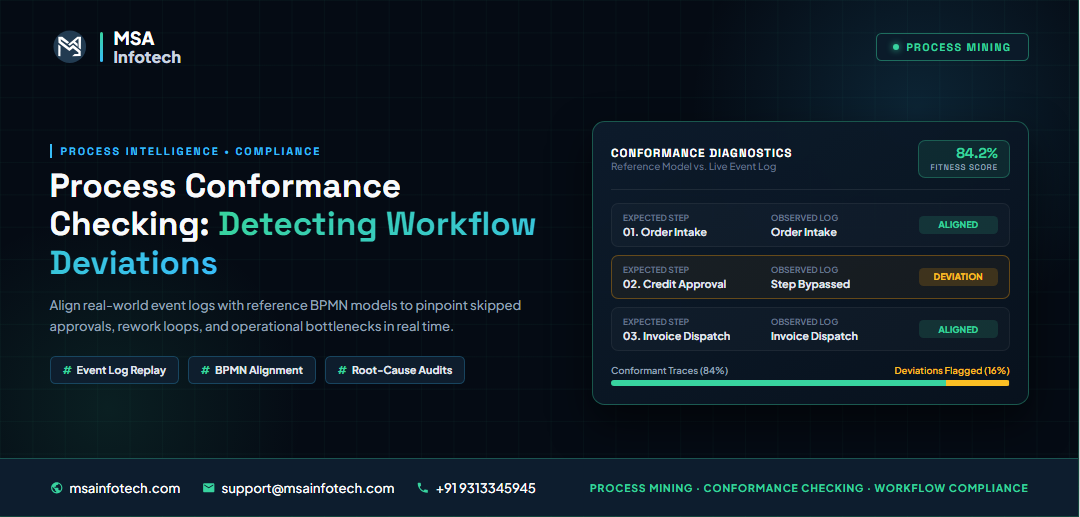
Process conformance checking uses process mining to compare event data from business systems with an expected process model. It helps organizations understand where actual execution differs from the defined process—and provides evidence to investigate why those differences occur.
Understanding Process Conformance Checking
Process conformance checking evaluates how closely a process, as it actually runs, matches a documented or designed process model. The model may represent a standard workflow, a regulatory requirement, an internal control, or an agreed operating procedure.
Process mining works with event logs captured by systems such as ERP, CRM, ticketing, finance, and workflow applications. A typical event record includes a case identifier, activity name, timestamp, and sometimes the user, department, or system that performed the activity. Arranging events into case timelines reveals the sequence followed in real operations.
Conformance checking compares observed sequences with the expected model. For example, if a purchase process requires a purchase request to be approved before a purchase order is issued, analysis can identify cases where the order was created before approval or where approval was not recorded.
Why Business Workflows Deviate from Standard Procedures
Workflow deviations do not always indicate misconduct or a broken process. They can arise from several operational and technical conditions:
· Unclear procedures: employees may interpret instructions differently when steps or responsibilities are not explicit.
· Manual workarounds: teams may use email, spreadsheets, or informal approvals when the official system is difficult to use.
· System integration gaps: activities completed in one application may not be recorded correctly in another, creating incomplete event trails.
· Exceptions and urgent requests: business needs may require an alternative route, but the exception may not be documented consistently.
· Process changes: workflows may evolve while process documentation remains outdated.
Understanding the reason behind a deviation is important. A valid exception should be distinguished from an avoidable bypass, a data-quality issue, or a process design problem.
How Process Mining Identifies Workflow Deviations
A conformance checking initiative generally follows a structured approach:
Collect event data: Extract relevant event logs from systems that record process activities. Confirm that case IDs, activity labels, and timestamps are reliable.
Define the expected process: Document the approved sequence, required controls, permitted alternatives, and legitimate exception paths
Prepare and map the data: Align system activity names with process-model activities, remove irrelevant technical events, and address missing or inconsistent records
Compare actual execution with the model: Use conformance techniques to identify missing, extra, reordered, or repeated activities and unexpected case routes
Review and validate findings: Examine affected cases with process owners to determine whether each deviation is meaningful and explainable
Track corrective action: Prioritize recurring or high-impact deviations, assign ownership, and monitor whether process changes reduce them
The result is more than a checklist of exceptions. Organizations can see which deviations recur, where they happen, which teams or systems are involved, and how they relate to process outcomes.
Business Impact of Process Deviations
Unnoticed deviations can create operational risk. A skipped approval may weaken an internal control; a repeated task may increase processing time; and an unexpected handoff may delay service delivery. Inconsistent execution can also make performance reporting less reliable because teams are not following the same operating path.
Conformance checking helps organizations focus on deviations that matter. Instead of treating every variation as equally important, process owners can assess frequency, business impact, control relevance, and whether the deviation is an approved exception. This supports targeted investigation and improvement.
Practical Business Applications
Process conformance checking can be applied across many business functions. Common examples include:
· Procure-to-Pay — check whether required requisition and purchase approvals occur before ordering or payment.
· Order-to-Cash — identify order handling steps that are skipped, repeated, or completed in an unexpected sequence.
· Finance and accounting — review whether journal entries, reconciliations, and close activities follow defined controls.
· Customer service — find cases where mandatory verification, escalation, or resolution steps are missed.
· IT service management — compare incident and change workflows with procedures, including approval and closure requirements.
The most useful starting point is often a process with clear rules, reliable event data, and a visible business concern—such as rework, delays, inconsistent approvals, or audit findings.
Best Practices for Effective Process Conformance
· Start with a focused process and a clear business question rather than attempting to analyze every workflow at once.
· Use a process model that reflects how the organization expects the process to operate, including approved exception paths.
· Validate event data before interpreting deviations; missing or inaccurate timestamps and activity mappings can produce misleading results.
· Involve process owners and frontline teams to distinguish legitimate variation from avoidable non-conformance.
· Prioritize findings by business impact, control risk, recurrence, and effort required to address them.
· Treat conformance checking as an ongoing improvement practice: review results after process changes and monitor corrective actions.
How MSA Infotech Can Help
MSA Infotech helps organizations explore data-driven approaches to process visibility and operational improvement. By assessing process data, identifying opportunities for analysis, and aligning insights with business objectives, organizations can build a practical foundation for process mining and continuous improvement.
Conclusion
Process conformance checking gives organizations a structured way to compare the process they intend to run with the process that actually takes place. By using event data and an agreed process model, business teams can identify workflow deviations, investigate their causes, and improve operational consistency.
When combined with reliable data, clear process ownership, and a practical improvement plan, process mining can help turn workflow deviations into actionable insight—supporting stronger controls, more efficient operations, and better-informed decisions.
“Turn workflow deviations into insights for more efficient and compliant business operations.”