
Data Reconciliation in ETL Pipelines
Ensuring Accuracy Across Source and Target Systems
Introduction
Modern
businesses collect data from multiple sources, including databases, business
applications, cloud platforms, and external systems. ETL (Extract, Transform,
Load) processes bring this information together and prepare it for reporting,
analytics, and business operations.
However,
successfully transferring data from one system to another does not
automatically guarantee its accuracy. Records may be missing, duplicated,
incorrectly transformed, or loaded incompletely. Even small inconsistencies can
affect reports, dashboards, and business decisions.
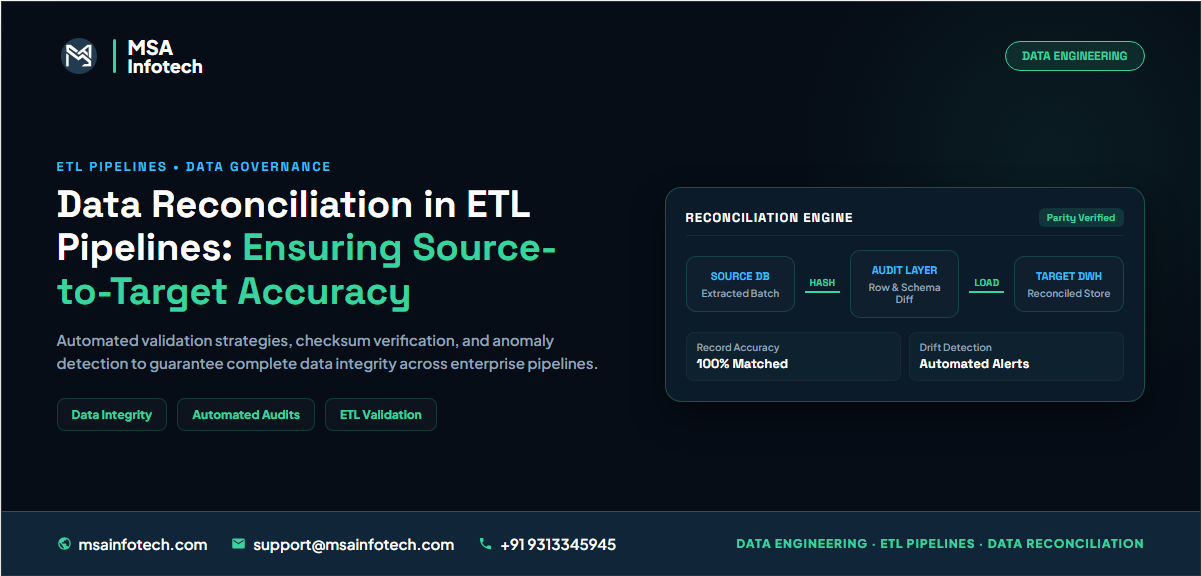
This is where data reconciliation becomes important. It helps organizations compare data across source and target systems, identify discrepancies, and maintain confidence in their data.
Understanding Data Reconciliation in ETL
Data
reconciliation is the process of verifying that information transferred through
an ETL pipeline remains accurate and consistent between the source and target
systems.
It involves
comparing selected data attributes, record counts, totals, and other validation
measures to identify differences.
For example,
when customer transaction data is transferred from an operational database to a
data warehouse, reconciliation checks can help verify whether the expected
records have been loaded and whether important transaction values remain
consistent.
By including reconciliation in ETL workflows, organizations can identify data issues before they affect downstream reporting and analytics.
Common Data Discrepancies in ETL Pipelines
Data
inconsistencies can occur at different stages of an ETL process. Understanding
common issues helps organizations design more effective validation checks.
· Missing Records: Some records may not reach the target
system because of extraction limitations, processing errors, or incomplete
loading.
· Duplicate Records: Repeated data entries can occur when
pipelines process the same records more than once or when duplicate
identification rules are insufficient.
· Incorrect Transformations: Data may change unexpectedly during
formatting, calculations, type conversions, or business rule application.
· Incomplete Data Loads: A pipeline may stop before processing
all expected records, resulting in differences between source and target
systems.
· Data Type and Format Differences: Source and target systems may use
different formats, precision levels, or field definitions, creating
inconsistencies during transformation.
Identifying these
issues early helps prevent unreliable information from entering business
reports and analytical systems.
Key Techniques for Validating Source and Target Data
Effective
reconciliation requires appropriate validation techniques. Organizations can
combine multiple methods depending on their data volume, business requirements,
and ETL architecture.
· Record Count Validation: Compare the number of records extracted
from the source with the number successfully loaded into the target, accounting
for any intentional filtering or transformation rules.
· Aggregate Validation: Compare important totals, such as
transaction amounts, quantities, or account balances, to identify unexpected
differences.
· Field-Level Validation: Check selected fields to confirm that
values have been transferred and transformed according to defined business
rules.
· Checksum and Hash Validation: Use calculated values to identify
changes in data across systems. These checks can help detect differences
without comparing every field individually.
· Business Rule Validation: Verify that the processed data follows
expected business conditions, such as valid transaction statuses or mandatory
customer information.
No single
technique is suitable for every situation. Combining record-level, aggregate,
and business-rule checks provides a stronger approach to data validation.
Automating Data Reconciliation Checks
Manually
comparing large datasets can be time-consuming and difficult to maintain.
Automating reconciliation checks makes validation a consistent part of the ETL
process.
Organizations
can configure automated checks at different pipeline stages, such as after
extraction, transformation, and loading.
An automated
reconciliation workflow can:
· Compare
source and target record counts.
· Validate
selected totals and important data fields.
· Identify
missing or duplicate records.
· Generate
reports highlighting detected discrepancies.
· Notify
relevant teams when validation checks fail.
For example, an
ETL pipeline can automatically compare daily transaction totals between a
source database and a data warehouse. If the values do not match within the
defined validation rules, the workflow can flag the batch for investigation.
Automation
reduces repetitive manual work and helps teams identify data quality issues
more consistently.
Handling Data Discrepancies and Maintaining Reliability
Identifying a
mismatch is only the first step. Organizations also need a structured process
to investigate and resolve discrepancies.
· Identify the affected data: Determine which records, fields, or
processing batches contain inconsistencies.
· Trace the issue: Review extraction logs, transformation
rules, loading results, and relevant pipeline checkpoints to locate the source
of the problem.
· Correct the underlying cause: Resolve issues such as incorrect
mapping, incomplete extraction, duplicate processing, or failed
transformations.
· Reprocess affected data: Where appropriate, reload or correct the
affected records using controlled recovery procedures.
· Document the resolution: Maintain validation results, error
details, and corrective actions to support auditing and future troubleshooting.
It is also
important to define acceptable tolerances. For example, some transformations
may intentionally change record counts or values. Reconciliation rules should
account for these expected differences rather than treating every variation as
an error.
Best Practices for Reliable Data Reconciliation
Organizations
can strengthen their ETL workflows by making reconciliation a planned part of
data integration rather than an activity performed only after problems occur.
· Define
clear validation rules according to business requirements.
· Perform
reconciliation at important stages of the ETL workflow.
· Use
automated checks for recurring data loads.
· Maintain
logs and reports for failed validation activities.
· Apply
suitable duplicate detection and data quality rules.
· Establish
clear procedures for investigating and resolving discrepancies.
· Review
reconciliation rules whenever source systems or data structures change.
A consistent
reconciliation strategy helps businesses maintain dependable data flows and
improves the reliability of information used across departments.
How MSA Infotech Supports Reliable Data Integration
Reliable data
integration requires more than moving information between systems. It involves
building structured data workflows, applying appropriate transformation logic,
and maintaining data quality throughout the process.
MSA Infotech
focuses on helping businesses develop and modernize technology solutions that
support their data management and integration requirements. Through data
integration, database development, business intelligence, and cloud-based
solutions, organizations can establish a stronger foundation for managing information
across different systems.
A well-designed
ETL strategy, supported by appropriate validation and monitoring practices, can
help businesses improve data consistency and make better use of their
information assets.
Conclusion
Data
reconciliation plays an important role in maintaining the accuracy and
reliability of ETL pipelines. By validating source and target data, automating
checks, and addressing discrepancies systematically, organizations can reduce
data inconsistencies and strengthen confidence in their reporting and
analytics.
Reliable data begins with accurate integration—and every successful data pipeline needs a way to verify the results.